





 Rivista in lingua italiana
riservata ai Soci SISA
Ultimo numero:
Anno 14 • N.4/2023
SISANews


HDL e rischio cardiovascolare. Una revisione sistematica della letteratura
L'associazione tra colesterolo HDL e malattie cardiovascolari è forte, ma non sempre è chiaramente indipendente dagli altri fattori di rischio lipidici. Qualche dubbio rimane soprattutto per l'ictus cerebrale la cui associazione con le HDL è meno costante. Alcuni dati suggeriscono anche che modificazioni del colesterolo HDL hanno effetti benefici sull'evoluzione delle malattie aterosclerotiche dando perciò un ulteriore supporto al significato protettivo delle HDL.

Prospective studies on the relationship between high-density lipoprotein cholesterol and cardiovascular risk: a systematic review
Chirovsky DR, Fedirko V, Cui Y, Sazonov V, Barter P.
Eur J Cardiovasc Prev Rehabil 2009;16:404-42
Epidemiological studies have extensively evaluated the association between high-density lipoprotein cholesterol (HDL-C) and cardiovascular disease (CVD) risk. The objective of this systematic review was to enumerate the number of original prospective studies that showed a significant association between HDL-C and CVD risk and provided evidence of the consistency of this association across other lipid risk factors. A systematic MEDLINE literature search identified 53 prospective cohort and five nested case-control studies that provided multivariate assessments of the association between HDL-C and CVD risk. Among these 58 prospective studies, 31 studies found a significant inverse association between HDL-C and CVD risk for all CVD outcomes and subpopulations studied, whereas 17 studies found a significant association for some CVD outcomes and/or subpopulations assessed. The ratio of studies that found a significant association out of the total studies identified was similar across all CVD outcomes, although there was less evidence for stroke and atherosclerotic outcomes. Only seven studies tested for the consistency of this association across other lipid risk factors, of which six studies suggested that the association was consistent across other lipid levels. In conclusion, the association between HDL-C and CVD risk is significant and strong, although further evidence may be needed to establish whether this association is consistent across other lipid risk factors. Furthermore, uncertainties remain regarding the mechanism in which HDL-C exerts its effects, suggesting a need for further research focused on new methods for reliable measurement.
Eur J Cardiovasc Prev Rehabil 2009;16:404-42

Area Soci
Eventi

 SISA LIPID ACADEMY - Corso avanzato di lipidologia clinica
Modena, 22-23 Giugno 2023
[continua a leggere]Giornale Italiano Arteriosclerosi
HoFH today
 Rivista Italiana della
Ipercolesterolemia
Familiare Omozigote
Anno 5 • N.1/2023
Rivista NMCD

Diateca
EAS Lipid Clinic Webinar - Le linee guida per le dislipidemie: presente e futuro
[continua a leggere]
[continua a leggere]
EAS Advanced Course in Rare Lipid Disease
[continua a leggere]
[continua a leggere]
Newsletter
Per essere informati sulle novità di S.I.S.A. iscrivetevi alla nostra newsletter inserendo
il vostro indirizzo di posta elettronica
il vostro indirizzo di posta elettronica
Progetto LIPIGEN
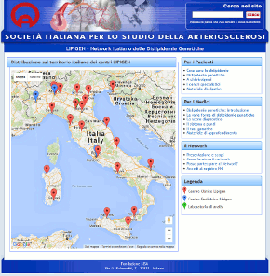
Nuovo sito dedicato al Progetto LIPIGEN
Progetto LIPIGEN - Vecchio portale
E' necessario essere loggati come utente
Lipigen per poter accedere alla pagina
PROject Statin Intolerance SISA
PROSISA – PROject Statin Intolerance SISA
E' necessario essere loggati come utente
PROSISA per poter accedere alla pagina
GILA - Lipoprotein Aferesi
Gruppo Interdisciplinare Lipoprotein Aferesi
(Accesso Gruppo GILA-Lipoprotein Aferesi)
E' necessario essere loggati come utente del Gruppo GILA per poter accedere
Gruppo Interdisciplinare Lipoprotein Aferesi
(Documentazione ad accesso libero)
Pagina informativa per medici e pazienti