




 Rivista in lingua italiana
riservata ai Soci SISA
Ultimo numero:
Anno 14 • N.4/2023
SISANews


Le statine migliorano le alterazioni visive correlate all'ipercolesterolemia
L'ipercolesterolemia può produrre aterosclerosi dei vasi retinici ed un danno neuronale con un meccanismo incerto. Ne risulta un difetto del campo visivo di varia gravità. Il trattamento con pravastatina, già dopo 6 mesi è risultato migliorare tutti i test campimetrici. Il meccanismo attraverso il quale la pravastatina esercita l'effetto positivo non è chiaro, anche se sembra legato alla riduzione del colesterolo LDL. Un miglioramento del campo visivo, seppure meno importante di quello rilevato nel gruppo trattato con pravastatina, si è osservato anche nel gruppo di confronto trattato solo con dieta ipolipidica ed in questo gruppo la riduzione del colesterolo LDL è stata naturalmente minore di quella osservata nel gruppo pravastatina. Sembra dunque esserci una relazione tra il miglioramento della campimetria e la riduzione del colesterolo LDL, anche se non si può escludere che l'effetto più marcato nel gruppo pravastatina sia dovuto, almeno in parte, ad un'azione specifica propria del farmaco.

Statins improve visual field alterations related to hypercholesterolemia
Alcalá A, Jansen S, Téllez T, Gómez-Huelgas R, Pérez O, Egido J, Farkouh ME.
Atherosclerosis 2010;209:510-14
OBJECTIVE: To determine whether lipid-lowering treatment with diet or statins would provide beneficial effects on visual field alterations associated with hypercholesterolemia. METHODS: 180 subjects with hypercholesterolemia were randomly assigned to a low fat diet (diet group) or to a low fat diet plus 40 mg/day of pravastatin (pravastatin group). At the beginning of the study and 6 months after the assigned treatment, all subjects underwent a computerized perimetry test and a determination of plasma concentration of glucose, total cholesterol, LDL-cholesterol (LDL-C), HDL-cholesterol (HDL-C) and triglycerides. RESULTS: At 6 months, both groups showed a significant decrease in total cholesterol, LDL-C and triglycerides compared to basal values, and a significant increase in the HDL-C. The pravastatin group had a significantly greater reduction in total cholesterol (-85+/-21 mg/dl) and LDL-C (-86+/-23 mg/dl) than the diet group (-28+/-9 and -28+/-10mg/dl, respectively). All perimetry parameters improved in both groups after the intervention period, although the improvement was greater in the pravastatin group. Using a general linear model, a significant effect of treatment with pravastatin compared to diet was observed in the improvement of all the perimetry parameters, whereas the change in LDL-C concentrations only had a significant effect on the improvement of one of them. CONCLUSION: In subjects with hypercholesterolemia, the decrease of blood lipids improves visual field parameters. The major beneficial effect noted with pravastatin, compared to diet, suggests that this effect could be due to the lipid-lowering and pleiotropic actions.
Atherosclerosis 2010;209:510-14

Area Soci
Eventi

 SISA LIPID ACADEMY - Corso avanzato di lipidologia clinica
Modena, 22-23 Giugno 2023
[continua a leggere]Giornale Italiano Arteriosclerosi
HoFH today
 Rivista Italiana della
Ipercolesterolemia
Familiare Omozigote
Anno 5 • N.1/2023
Rivista NMCD

Diateca
EAS Lipid Clinic Webinar - Le linee guida per le dislipidemie: presente e futuro
[continua a leggere]
[continua a leggere]
EAS Advanced Course in Rare Lipid Disease
[continua a leggere]
[continua a leggere]
Newsletter
Per essere informati sulle novità di S.I.S.A. iscrivetevi alla nostra newsletter inserendo
il vostro indirizzo di posta elettronica
il vostro indirizzo di posta elettronica
Progetto LIPIGEN
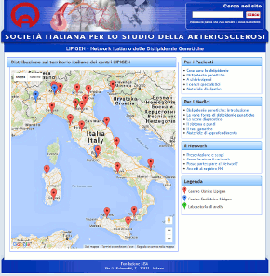
Nuovo sito dedicato al Progetto LIPIGEN
Progetto LIPIGEN - Vecchio portale
E' necessario essere loggati come utente
Lipigen per poter accedere alla pagina
PROject Statin Intolerance SISA
PROSISA – PROject Statin Intolerance SISA
E' necessario essere loggati come utente
PROSISA per poter accedere alla pagina
GILA - Lipoprotein Aferesi
Gruppo Interdisciplinare Lipoprotein Aferesi
(Accesso Gruppo GILA-Lipoprotein Aferesi)
E' necessario essere loggati come utente del Gruppo GILA per poter accedere
Gruppo Interdisciplinare Lipoprotein Aferesi
(Documentazione ad accesso libero)
Pagina informativa per medici e pazienti