




 Rivista in lingua italiana
riservata ai Soci SISA
Ultimo numero:
Anno 14 • N.4/2023
SISANews


Microbiota intestinale e malattie cardiovascolari
Un altro fattore di rischio cardiovascolare si va ad aggiungere ad una serie già numerosa. Si tratta della trimetilamina N-ossidata, (TMAO) un prodotto dell'ossidazione epatica della trimetilamina, derivata dal metabolismo ad opera dei batteri intestinali della colina, che nell'uomo viene assunta prevalentemente come lecitina alimentare. La TMAO favorisce l'accumulo di colesterolo nei macrofagi e, in accordo, è stata riscontrata una relazione positiva tra alti livelli di TMAO ed incidenza di eventi cardiovascolari maggiori. Antibiotici a largo spettro somministrati per via orale riducono la produzione di TMAO e la sospensione della terapia antibiotica è seguita da una pronta ripresa della produzione di TMAO, dimostrando così la diretta dipendenza del livello di TMAO e flora batterica intestinale. Secondo gli autori, TMAO è un fattore di rischio indipendente per l'aterosclerosi; la terapia antibiotica potrebbe rappresentare una nuova strategia per ridurre il rischio cardiovascolare?

Intestinal microbial metabolism of phosphatidylcholine and cardiovascular risk
Tang WH, Wang Z, Levison BS, Koeth RA, Britt EB, Fu X, Wu Y, Hazen SL
N Engl J Med 2013;368:1575-1584
BACKGROUND: Recent studies in animals have shown a mechanistic link between intestinal microbial metabolism of the choline moiety in dietary phosphatidylcholine (lecithin) and coronary artery disease through the production of a proatherosclerotic metabolite, trimethylamine-N-oxide (TMAO). We investigated the relationship among intestinal microbiota-dependent metabolism of dietary phosphatidylcholine, TMAO levels, and adverse cardiovascular events in humans.
METHODS: We quantified plasma and urinary levels of TMAO and plasma choline and betaine levels by means of liquid chromatography and online tandem mass spectrometry after a phosphatidylcholine challenge (ingestion of two hard-boiled eggs and deuterium [d9]-labeled phosphatidylcholine) in healthy participants before and after the suppression of intestinal microbiota with oral broad-spectrum antibiotics. We further examined the relationship between fasting plasma levels of TMAO and incident major adverse cardiovascular events (death, myocardial infarction, or stroke) during 3 years of follow-up in 4007 patients undergoing elective coronary angiography.
RESULTS: Time-dependent increases in levels of both TMAO and its d9 isotopologue, as well as other choline metabolites, were detected after the phosphatidylcholine challenge. Plasma levels of TMAO were markedly suppressed after the administration of antibiotics and then reappeared after withdrawal of antibiotics. Increased plasma levels of TMAO were associated with an increased risk of a major adverse cardiovascular event (hazard ratio for highest vs. lowest TMAO quartile, 2.54; 95% confidence interval, 1.96 to 3.28; P<0.001). An elevated TMAO level predicted an increased risk of major adverse cardiovascular events after adjustment for traditional risk factors (P<0.001), as well as in lower-risk subgroups.
CONCLUSIONS: The production of TMAO from dietary phosphatidylcholine is dependent on metabolism by the intestinal microbiota. Increased TMAO levels are associated with an increased risk of incident major adverse cardiovascular events. (Funded by the National Institutes of Health and others.).
N Engl J Med 2013;368:1575-1584

Area Soci
Eventi

 SISA LIPID ACADEMY - Corso avanzato di lipidologia clinica
Modena, 22-23 Giugno 2023
[continua a leggere]Giornale Italiano Arteriosclerosi
HoFH today
 Rivista Italiana della
Ipercolesterolemia
Familiare Omozigote
Anno 5 • N.1/2023
Rivista NMCD

Diateca
EAS Lipid Clinic Webinar - Le linee guida per le dislipidemie: presente e futuro
[continua a leggere]
[continua a leggere]
EAS Advanced Course in Rare Lipid Disease
[continua a leggere]
[continua a leggere]
Newsletter
Per essere informati sulle novità di S.I.S.A. iscrivetevi alla nostra newsletter inserendo
il vostro indirizzo di posta elettronica
il vostro indirizzo di posta elettronica
Progetto LIPIGEN
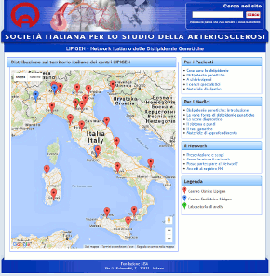
Nuovo sito dedicato al Progetto LIPIGEN
Progetto LIPIGEN - Vecchio portale
E' necessario essere loggati come utente
Lipigen per poter accedere alla pagina
PROject Statin Intolerance SISA
PROSISA – PROject Statin Intolerance SISA
E' necessario essere loggati come utente
PROSISA per poter accedere alla pagina
GILA - Lipoprotein Aferesi
Gruppo Interdisciplinare Lipoprotein Aferesi
(Accesso Gruppo GILA-Lipoprotein Aferesi)
E' necessario essere loggati come utente del Gruppo GILA per poter accedere
Gruppo Interdisciplinare Lipoprotein Aferesi
(Documentazione ad accesso libero)
Pagina informativa per medici e pazienti